The journal · Guide
Why your guests don’t join in the experience, and how to fix it
When an experience stays empty, the cause is almost always one of three: it’s in the wrong place, nobody gets things started, or it comes at the wrong moment of the evening.
Published on · 4 min read
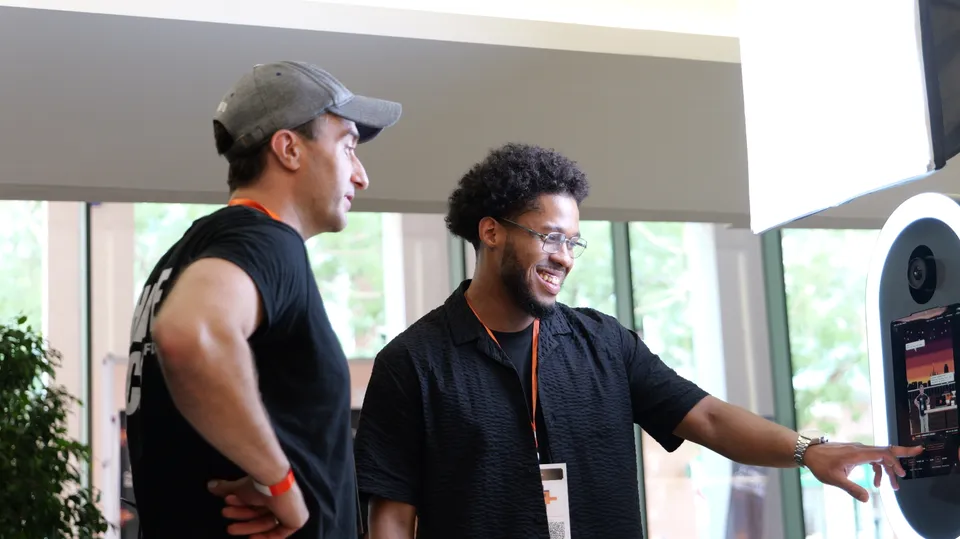
When an experience stays empty, the cause is almost always one of three: it’s in the wrong place, nobody gets things started, or it comes at the wrong moment of the evening. The set-up itself is rarely to blame. Here is what we see event after event, and the fixes that cost nothing.
Cause 1 — the experience is set up in a blind spot
An experience tucked away at the back of the room, behind the bar or next to the toilets won’t get used. Guests move between three hubs: the entrance, the bar and the buffet. Anything off those routes becomes invisible.
The fix: place the experience on the route between two hubs, never at the far end of the room. A spot visible from the entrance makes an immediate difference, because guests have noticed it before they’ve even taken their coats off.
Cause 2 — nobody dares to go first
This is the strongest barrier, and the most underestimated. In a work setting, nobody wants to be the first to put themselves on show in front of their colleagues and leadership. Without anyone to get it going, an experience can sit empty for an hour, then fill up all at once as soon as three people have had a go.
The fix: someone whose job is to bring in the first groups. A host on hand turns an experience from a few curious onlookers into a steady flow. If your supplier offers the host as an option, it isn’t optional.
A second lever, at no cost: ask two or three people from your team to get things moving in the first fifteen minutes. Social proof does the rest.
Cause 3 — the wrong moment in the running order
An experience open during the speeches serves no purpose. Open it too late and it misses the half of the guests who have already left.
| Moment | What happens | Verdict |
|---|---|---|
| On arrival, with the drinks reception | Guests arrive in groups and look for something to do with their hands | The best moment |
| During the speeches | Attention is taken up elsewhere, and the noise gets in the way | Close it |
| Right after dinner | Tables break up and people start moving around again | Natural second peak |
| At the very end of the evening | Only the last few are left | Too late |
The signal that never lies
An experience that works brings people back a second time. Not a queue at opening, but groups who come back later with other colleagues. It’s the only reliable indicator, and you can gauge it with the naked eye during the evening.
If nobody comes back, the experience didn’t make anyone want to talk about it. Then the problem really is the set-up.
Frequently asked questions
Should guests be made to take part?
No, and set-ups that force participation have the opposite effect. What works is making the first step easy and low-stakes.
How long should an experience stay open?
Three hours covers most evenings. Above 250 guests, it’s better to extend the duration than to add more set-ups.
Does an experience work with an international audience?
Yes, as long as guests are welcomed in their own language. In Barcelona, a room rarely speaks just one language.
You may also like
What to do with your corporate party photos: 6 uses
In a single night, a corporate party produces more authentic images than six months of content production.
4 min read
Photo booth, 360, AI or merch bar: which to choose?
There are four types of photo experience, and they don’t produce the same thing.
5 min read
Last-minute corporate party entertainment in December
If you are looking for entertainment less than six weeks before your party, you are not late: you are in the most common situation.
4 min read